Electric versus gasoline
A comparison of the electric Porsche 356 with its gasoline-powered cousin.
| SPECIFICATION | ELECTRIC 356 | GASOLINE 356 |
| Power system | ||
| Type | AC electric motor | air-cooled engine |
| Power at peak torque (1) | 57 kW | 52 kW |
| Useful RPM maximum | 6,500 | 6,000 |
| Expected power train life (2) | 385,000 miles | 100,000 miles |
| Transaxle final gear ratio | 3.88 to 1 | 4.42 to 1 |
| Energy storage | ||
| Capacity (3) | 23.0 kWh | 490.0 kWh |
| Weight (battery or gas tank) (4) | 450 lbs | 106 lbs |
| Energy density | 109 Wh/kg | 12,200 Wh/kg (5) |
| Storage format | 36 LiFePO4 cells | 13.8 gallon fuel tank |
| Performance | ||
| Top speed (6) | 110 mph | 110 mph |
| Useful range (7) | 125 miles | 250 miles |
| Efficiency (8) | ||
| Miles per gallon or equivalent (9) | 125 mpg | 20 mpg |
| Cost per 10,000 miles (10) | $186 | $2,000 |
FOOTNOTES
- Lithium estimate based on 4th gear at 4200 rpm; gasoline estimate based on 70 bph of the 1582cc overhead cam flat-four Porsche engine at 4500 rpm
- Lithium estimate based on charge cycle life calculated using 30% DOD specification for average depth of discharge; gasoline estimate based on 2,000 hour life before major overhaul at average 50 mph speed
- Lithium based on 3.2 nominal voltage, 200 Ah capacity, and 36 LiFePO4 cells (lithium cells lose approximately 2.7% of capacity per year, known as calendar fade); gasoline based on fuel tank capacity
- Lithium LiFePO4 cell weight 12.5 lbs; gasoline average weight 6.25 lbs/gallon, tank weight 20 lbs with pump and filler tube
- Based on average gasoline energy density
- Effective maximum speed based on chassis, suspension, and body air resistance
- Lithium estimate based on 165 Wh/mile, 10% SOC; gasoline estimate based on 20 mpg, 10% fuel residual of 1.3 gallons
- Assumes average U.S. residential electricity rate of $.11/kWh and $4/gal average U.S. fuel cost at 18 mpg
- Calculated using average $4/gal gasoline versus $0.0186/mile electric cost
- Based on average full charge cost of $2.70, $0.0186/mile with electricity; gasoline at $0.20/mile based on $4/gal and 20 mpg
The Vehicles
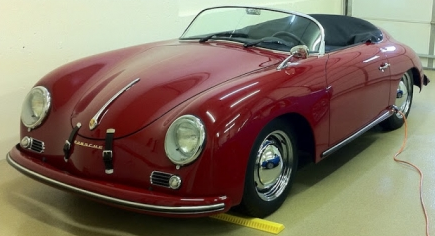
Porsche 356 Speedster
The iconic Porsche Speedster proved to be an excellent EV conversion candidate due to its low weight, relatively simple design, and ample front/rear compartments for mounting prismatic lithium battery cells. Weight distribution was improved over the original rear engine configuration with better acceleration and overall performance.
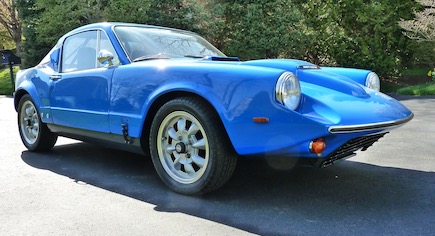
Saab Sonett
The unusual fiberglass Sonett, originally powered by a Ford V4 engine, combines a low center of gravity and front wheel drive, optimal for our high performance EV conversion. Without the need to accommodate a long drive train, the space behind the two seats was used for additional batteries. The original four-speed transmission remains intact along with the braking system.